
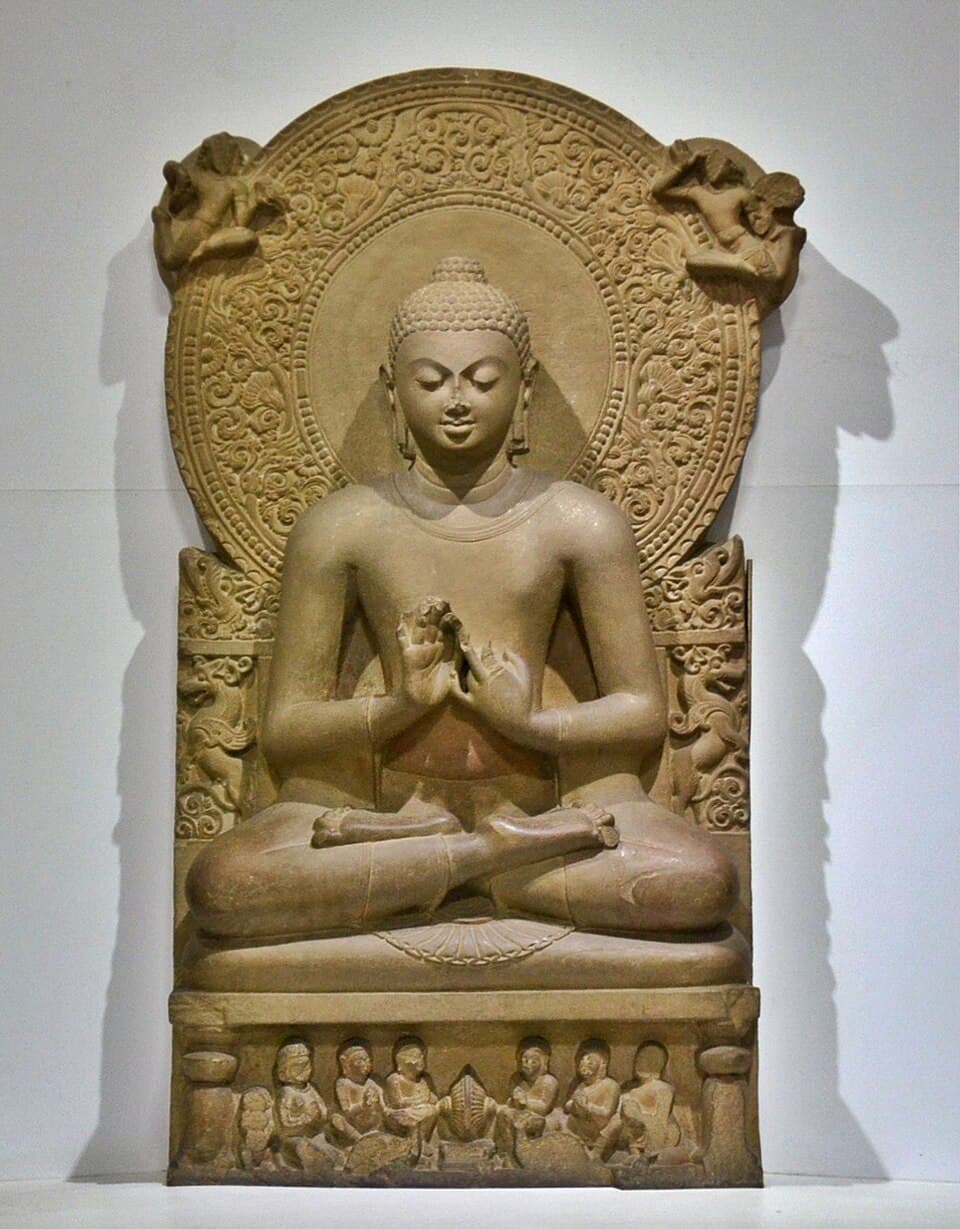
Historical sandstone sculpture of Shakyamuni Buddha preaching the First Sermon (c. 5th century CE, Sarnath Museum).
Gautama Buddha
Foundational philosopher and spiritual teacher whose profound critique of hereditary ritual hierarchy, emphasis on ethical conduct, and rational inquiry established an enduring philosophical wellspring for modern egalitarian movements.
Documented Biography
Siddhartha Gautama lived in ancient northern India (the Shakya republic, in the border region of modern Nepal and India). While traditional Buddhist accounts offer varying chronologies, modern historical scholarship generally places his life and teachings around the 5th century BCE.
Renouncing princely luxury to confront the universal reality of suffering (dukkha), Gautama attained enlightenment (bodhi) at Bodh Gaya and delivered his inaugural discourse—the Dhammacakkappavattana Sutta—at the Deer Park in Sarnath, setting in motion the Wheel of the Dhamma.
Central to the Buddha's philosophical revolution was his rejection of metaphysical dogmatism, priestly infallibility, and hereditary ritual status (varna). In dialogues recorded in the Pali Canon (such as the Assalayana Sutta and Vasettha Sutta), he reasoned that human worth is determined by voluntary moral actions (kamma) rather than ancestral birth.
By admitting people of all social strata—including artisans, barbers, and the dispossessed—into the monastic order (Sangha), and by preaching in the vernacular languages of the populace rather than sacred scholastic Sanskrit, the Buddha established an intellectual tradition that Dr. B. R. Ambedkar and subsequent Bahujan thinkers embraced as the philosophical foundation of democratic equality.
Key Contributions & Historical Impact
Philosophical Critique of Hereditary Hierarchy
Systematically questioned the divine origin of the caste system, arguing that moral character and conduct, not birth, define spiritual and social integrity.
Democratisation of Wisdom in Vernacular Tongues
Rejected elite esoteric language, imparting discourses in Prakrit and Pali so philosophical inquiry was accessible to all members of society.
Creation of an Egalitarian Sangha
Instituted a communal monastic order governed by collective deliberation, where class and lineage were dissolved upon entry.
Foundation of Modern Anti-Caste Intellectual Thought
Served as the spiritual and intellectual compass for Dr. B. R. Ambedkar's democratic renewal and the 1956 mass embrace of Buddhism.
Major Works & Milestones
- Dhammacakkappavattana Sutta (Setting in Motion the Wheel of Dhamma)
- Teaching of the Four Noble Truths and the Noble Eightfold Path
- Founding of the Monastic Sangha open to all castes and genders
- Inspiration for the 20th-century Navayana Buddhist Movement
Archival & Secondary Sources
Bahujan Bichara Mancha maintains documentation integrity by referencing reliable public-domain, governmental, and peer-reviewed sources.
- Encyclopaedia Britannica — The BuddhaEncyclopediaView Source Archive ↗
- Archaeological Survey of India — Sarnath & Buddhist Circuit CollectionsGovernment ArchiveView Source Archive ↗
- Dr. B. R. Ambedkar: 'The Buddha and His Dhamma' (Critical Edition, Oxford University Press)AcademicView Source Archive ↗