
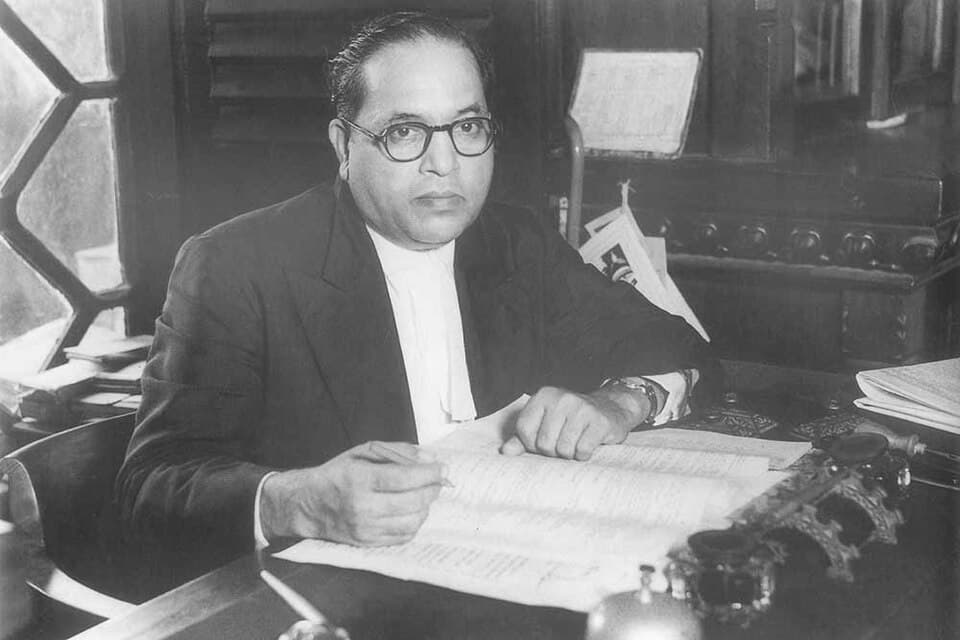
Dr. Bhimrao Ramji Ambedkar in 1950, holding a bound volume of the Constitution of India.
Dr. B. R. Ambedkar
Scholar, economist, legal luminary, and civil rights pioneer who chaired the Drafting Committee of the Constitution of India and led epochal struggles for social justice, human dignity, and democratic constitutionalism.
Documented Biography
Bhimrao Ramji Ambedkar was born on 14 April 1891 in the military cantonment town of Mhow (now Dr. Ambedkar Nagar, Madhya Pradesh). Overcoming severe institutional untouchability, he pursued advanced studies across continents, earning doctorates from Columbia University in New York and the London School of Economics, as well as qualifying for the Bar at Gray's Inn, London.
Returning to India, Ambedkar launched rigorous civil rights campaigns to secure basic civic entitlements for depressed communities. He led the historic Mahad Satyagraha in March 1927 to assert the right of untouchables to draw water from the public Chavadar Tank, and subsequent movements for access to public temples.
As a brilliant constitutional thinker, Ambedkar represented the depressed classes at the Round Table Conferences in London (1930–1932). Following Indian independence, Prime Minister Jawaharlal Nehru appointed him Independent India's first Minister of Law and Justice, and the Constituent Assembly elected him Chairman of the Drafting Committee.
Ambedkar embedded fundamental rights, universal adult suffrage, the legal abolition of untouchability (Article 17), and protective representation mechanisms directly into the Constitution. In October 1956, at Deekshabhoomi in Nagpur, he embraced Buddhism along with hundreds of thousands of followers, inaugurating the modern Buddhist revival in India.
Key Contributions & Historical Impact
Principal Architect of the Constitution of India
Chaired the Drafting Committee (1947–1949), ensuring the inclusion of fundamental rights, judicial remedies, civil liberties, and statutory mechanisms against discrimination.
First Minister of Law and Justice
Championed modern legal codification, fundamental civil rights, and progressive family law reforms through the Hindu Code Bill.
Pioneered Civil Rights Movements
Organised the Mahad Satyagraha (1927) and Kalaram Temple Satyagraha (1930), establishing civil equality and public access as non-negotiable human rights.
Revival of Buddhism (1956)
Led the mass conversion at Nagpur, interpreting Buddhism through a rationalist, ethical, and egalitarian framework in his final work 'The Buddha and His Dhamma'.
Major Works & Milestones
- Castes in India: Their Mechanism, Genesis and Development (1916)
- The Problem of the Rupee: Its Origin and Its Solution (1923)
- Annihilation of Caste (1936)
- Who Were the Shudras? (1946)
- The Buddha and His Dhamma (1957, posthumous)
Archival & Secondary Sources
Bahujan Bichara Mancha maintains documentation integrity by referencing reliable public-domain, governmental, and peer-reviewed sources.
- Dr. Babasaheb Ambedkar: Writings and Speeches (Ministry of Social Justice and Empowerment)Government ArchiveView Source Archive ↗
- Encyclopaedia Britannica — Bhimrao Ramji AmbedkarEncyclopediaView Source Archive ↗
- Columbia University — Dr. B. R. Ambedkar Life & Work ArchiveAcademicView Source Archive ↗